Understanding Intentions and Social Goals behind User Behavior
Understanding the social signals that indicate friendship — and training a machine to read them from video.
Abstract
Rapport between two strangers is established over time through the use of conversational strategies. For example, a person might reveal something personal about herself, which would then transition the conversation from the polite to the intimate.
This project aimed to determine if participants in a peer tutoring setting were friends from video, voice transcripts, and manual video annotations. For the final deliverable, I built a classifier that could determine friendship with high accuracy using 28 different features extracted from these sources.
Context
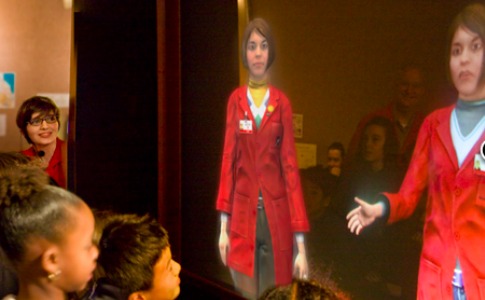
The ArticuLab at Carnegie Mellon studies how two people in a dyadic setting create, maintain, and break rapport. The end goal: a virtual peer tutor that can build genuine rapport with a student — knowing when to push, when to ease off, and when the relationship has warmed enough to try something harder.
My contribution was a specific subproblem: can a classifier detect whether two people are friends from video of them peer tutoring together? Friendship is a strong prior indicator of rapport, and detecting it automatically would let the tutoring agent calibrate its social strategy from the start of a session.
Literature Review
I began with a survey of existing research in rapport, nonverbal behavior, and social signal processing. The key nonverbal features that distinguished pairs with established rapport: smiling frequency, head nods, head shakes, and eye gaze patterns.
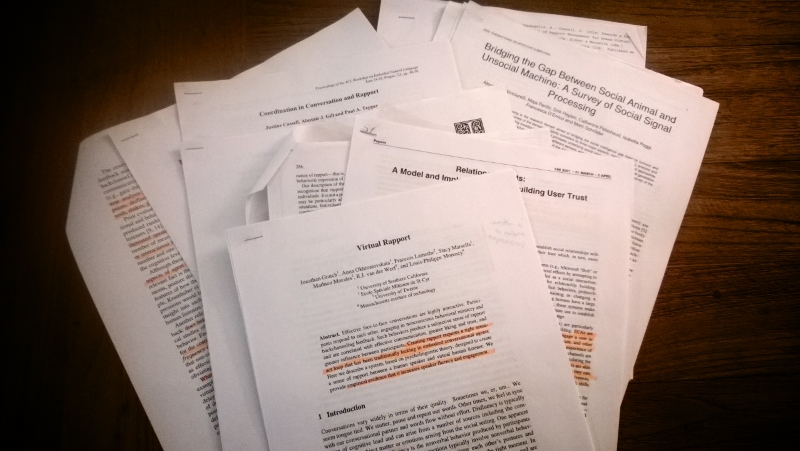
I also consulted a project member specializing in verbal behavior to identify conversational strategies — specific phrasings and patterns in transcripts that signal intimacy, disclosure, and alignment.
Feature Extraction
I developed a toolkit to extract features from three sources:
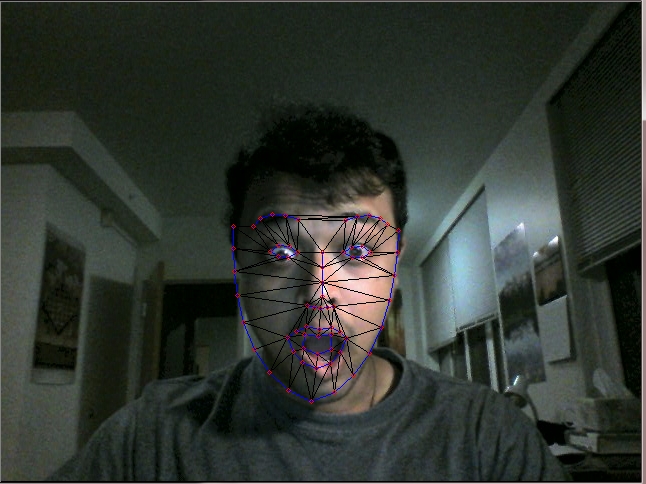
- Video: using my Modified FaceTracker from the senior thesis to extract smile frequency, head position, and head movement for each participant
- Transcripts: NLP-based extraction of rapport-related conversational strategies (self-disclosure, topic reciprocation, hedging)
- Manual annotations: frame-level behavioral tags from the ArticuLab annotation protocol
The FaceTracker gave me continuous emotional state estimates and head kinematics across each tutoring session — the same engine I had built and validated in my thesis work.
Classifier
I trained an SVM classifier on 28 extracted features, iterating on the feature set until detection accuracy was high on held-out sessions. The final model could determine whether two participants were friends from a tutoring video with strong accuracy — providing the rapport agent with a useful social prior before a session’s first exchange.
Role
Sole researcher and developer on the detection component. Supervised by Alexandros Papangelis. Built the feature extraction pipeline, adapted the FaceTracker for multi-person dyadic video, and trained and evaluated the final classifier.